

The Cold Hard Facts of Pennsylvania Child Support
Pennsylvania child support guidelines look at the portion of a household net income used for the benefit of the children of that household and then assigns a portion of that amount to each parent based on that parent’s contribution to the adjusted net household income. Sounds complicated, right? It really isn’t. Let’s walk through an example.
As promised, here’s a closer look at how Pennsylvania calculates child support. So far, you know that child support is based off statutory guidelines, but how do they work?
The child support guidelines look at the portion of a household net income used for the benefit of the children of that household and then assigns a portion of that amount to each parent based on that parent’s contribution to the adjusted net household income. Sounds complicated, right? It really isn’t. Let’s walk through an example.
Parent 1 and Parent 2 have two children together. Parent 1 works a job earning $12.00/hour for 80 hours/paycheck and paid every other week. Parent 2 earns $16.25/hour for 80 hours/paycheck and paid every other week.

Parent Income Breakdown
If Parent 1 and Parent 2 were an intact family, their adjusted net household income would be $1785. Parent 1 earns 43% of the total adjusted net household income and Parent 2 earns 57%.
According to the Basic Child Support Schedule, a household with a combined adjusted net income of $1,750 would spend $614 for the benefit of its two children. Parent 1 would be responsible for 43% of the $614; Parent 2 would be responsible for the remaining 57%.

Basic Child Support Schedule
The child support guidelines assume the parent who owes support has custody of the children 30% of the time. Assuming Parent 1 has primary custody of the two children, Parent 2 would owe Parent 1 $349.98 in child support each month.
A few other things to remember:
First, an award of child support is retroactive, meaning the monthly support obligation is due back to the date of filing. Keep that in mind if you are the obligor (i.e., the parent who will have to pay support). It’s in your best interest to provide the information and have the amount calculated sooner rather than later to minimize the arrears due.
Second, child support is calculated on a household basis which considers the total number of children, but not on a per child basis. Let’s assume you’re the obligor and have four children. Your oldest graduates from high school, and you file to terminate the support of that child. Your overall child support obligation will likely decrease but it will not decrease by 25%. Why? The formula assumes that the parent receiving the support will still have the same mortgage payment and monthly bills associated with a home for the remaining minor children and you’ll still be responsible for your percentage of the intact family figure. Take another look at the chart above. The difference between the monthly expenses for two and three children for an intact family is only $18.00, not 50%.
Lastly, a hearing officer may deviate from the statutory guidelines if the facts warrant it. Do the parents have 50/50 custody? Does one parent pay for medical insurance for the children out-of-pocket? Does one parent pay for all the children’s daycare expenses or unpaid medical expenses? Does one parent pay private school tuition? The court may consider all these things and may deviate from the statutory child support amount.
*Disclaimer: this article is for informational purposes only. It is not providing legal advice. It does not create an attorney-client relationship

Alimony, Spousal and Child Support…Oh, My!
The end of a marriage is a difficult time for anyone, and the financial consequences of untangling two lives can make it even worse. Although each is unique, alimony, spousal support and child support are all similar in the sense that one spouse is making a payment for the benefit of someone else (the other spouse or the parties’ children).
The end of a marriage is a difficult time for anyone, and the financial consequences of untangling two lives can make it even worse. Although each is unique, alimony, spousal support and child support are all similar in the sense that one spouse is making a payment for the benefit of someone else (the other spouse or the parties’ children).
In Pennsylvania, there are three types of spousal support/alimony, spousal support, alimony pendente lite and alimony. Depending on what stage of the divorce process you’re currently in will determine what type of support you may have a right to receive. (For more information click here.) When two people marry each other, they generally combine finances, enjoying a standard of life neither could achieve without the other. Even if both parties work fulltime, it is likely one spouse is a “dependent spouse,” meaning one spouse earns less than the other. The dependent spouse may receive spousal support or alimony pendente lite. As part of dividing the marital estate, a court may order one spouse to pay the dependent spouse alimony. Keep in mind that alimony is not guaranteed, as it is a secondary remedy for the Court to use if it is unable to equitably divide the marital estate. Think liquid assets versus non-liquid assets (i.e., something that can be sold for cash versus a retirement account that would incur a substantial penalty for an early withdrawal before a certain age).

Child support, on the other hand, is support for the benefit of minor children. The purpose of child support is to help ensure the children enjoy a standard of life like what they enjoyed before their parents’ separating or divorcing. If you, your children, and the other parent of your children do not live under the same roof, one parent may owe child support to the other.

The Domestic Relations section of your county’s Court of Common Pleas handles child support claims. When one parent files for child support, both parents provide income and expense information. The hearing officer then determines the adjusted net income of each parent and then uses those figures to calculate child support, applying statutory guidelines. We’ll take a closer look at the breakdown of the calculation in our next article.
There are two sides to each type of support: the spouse who is having to pay the support and the spouse who is relying on the support to make ends meet. Neither position is ideal. If you find yourself in a situation where you want to be sure the support calculations for your case are correct, give us a call. We’d love the opportunity to discuss the specifics of your case with you.
*Disclaimer: this article is for informational purposes only. It is not providing legal advice. It does not create an attorney-client relationship.

So your marriage is coming to an end. Now what? Part II
You’ve gotten over the initial shock of realizing that your marriage is over. Now what? Well, now you have some tough decisions to make starting with what do you want out of the divorce. Some preliminary matters to work though include who stays in the house, who gets physical custody of the children, who gets possession of the family pet, and how will the assets/debts be divided.
You’ve gotten over the initial shock of realizing that your marriage is over. Now what? Well, now you have some tough decisions to make starting with what do you want out of the divorce. Some preliminary matters to work though include who stays in the house, who gets physical custody of the children, who gets possession of the family pet, and how will the assets/debts be divided.
Residing in the marital home to the exclusion of your spouse is known as exclusive possession. If there are children involved, the spouse having primary physical custody generally resides in the house to minimize the displacement of the children.
If the parties cannot agree on physical custody, the court will look at 16 factors to ultimately decide what is in the best interests of the children. Most courts believe it’s important for children to spend equal time (or as close to equal time as possible) with each parent. You’ll want to keep that in mind if you choose to move out and get a place of your own. The farther you live from your spouse, the harder it is to make joint custody work and the harder it is on your children.
If you’re like me, your family pet is more than a pet, he’s a four-legged family member. Unfortunately, the law doesn’t give him the same love you do. Pets are considered marital property. If the parties can’t agree, the court will decide who gets the pet in equitable distribution.
Generally, the party living in the marital home is responsible for the bills as well. If you’re driving a vehicle, you’re most likely responsible for the costs associated with that vehicle. Each party is generally responsible for bills in his/her own name, and history helps determine who is responsible for joint bills. Any payments made during the separation or while the divorce is pending towards joint bills or for the benefit of joint assets may be offset during equitable distribution.
Your assignment: make a list of individual and marital assets and debts. Gather copies of titles, account statements, appraisals, etc. Each party will have to prepare an inventory of what property needs to be divided.
If you are trying to determine what to do next, give us a call at 724.550.6970. We offer a free 30-minute consultation and would love to discuss how we may help you with your divorce.
*Disclaimer: this article is for informational purposes only. It is not providing legal advice. It does not create an attorney-client relationship.

So your marriage is coming to an end. Now what?
Although no one gets married planning for a divorce, sometimes people are better off apart. Maybe they’re better as friends or maybe they’re so toxic together that divorce is the healthiest option for everyone involved. The end of a relationship – even more so a marriage – can be a tough thing to process both mentally and emotionally.
Although no one gets married planning for a divorce, sometimes people are better off apart. Maybe they’re better as friends or maybe they’re so toxic together that divorce is the healthiest option for everyone involved. The end of a relationship – even more so a marriage – can be a tough thing to process both mentally and emotionally. In the next few posts, we’ll look at some things to consider if you find yourself at the end of your marriage road.
First, remember that the two of you loved each other at some point or you wouldn’t be married in the first place. Try to use that memory as the foundation for your decisions moving forward, especially if there are children involved. Revenge may sound good in theory, but is it worth the time, energy, heart and money it will cost you? Probably not. Getting back at the spouse who hurt you or taking your spouse to the cleaners may make you feel better now, but it’s likely to cost you (or, more importantly, your children) in the end. Couples who can amicably dissolve their marriage are more likely to be able to effectively coparent post-divorce.
Research reveals that anywhere from 2 to 10 percent of divorce cases are decided by a judge. That means an overwhelming majority of divorces are settled amicably between the parties (with or without their lawyers) or in mediation. You have more control over the outcome of the situation if you are willing to negotiate in good faith with the other party than you do if the decision goes to a divorce master or even the judge. Would you rather control your destiny or let a stranger who is only going to hear a portion of your story decide for you?
On top of giving you more control over the outcome, uncontested divorces are resolved in a fraction of the time as a contested divorce. An uncontested divorce can be finalized in roughly 120-150 days, depending on the specific facts of your circumstances. A contested divorce, which requires a separation period of at least one year, may take up to 15 months or even longer.
If you or your spouse has decided it’s time to end your marriage, give us a call at 724.550.6970. We offer a free 30-minute consultation and would love to discuss how we may help you with your divorce.
*Disclaimer: this article is for informational purposes only. It is not providing legal advice. It does not create an attorney-client relationship.

Naughty or Nice - Custody Edition
The holiday season is upon us, and we’re just as excited about Santa’s arrival as you are! Did you know that Santa’s Naughty and Nice list isn’t only for children? That’s right. Santa’s also making a list of parents dealing with custody issues, and he’s checking it twice.
The holiday season is upon us, and we’re just as excited about Santa’s arrival as you are! Did you know that Santa’s Naughty and Nice list isn’t only for children? That’s right. Santa’s also making a list of parents dealing with custody issues, and he’s checking it twice.
Are you in the middle of a custody battle? Is your name on the Naughty List or the Nice List? Maybe you and your ex simply cannot see eye-to-eye, I mean, your ex is an ex for a reason, right? Maybe your ex is constantly making mountains out of molehills. Maybe your ex refuses to cooperate with even the slightest deviation from your custody order. And maybe all of these things are making you react instead of respond.
Disagreements over custody matters can be stressful and can also lead parents to behave in a way they normally wouldn’t. Don’t fall victim to the temptation to react! Reacting can lead to impulsive decisions that are not in the best interest of your children. Reacting can also land your name on the Naughty List.
You may find your name on the Naughty List if you’re discussing your custody battle with your children. Children are not pawns in the chess game of custody you’re playing with your ex. If you refrain from including your children in adult matters, you can be sure your children aren’t ending up in the middle of an unfair situation.
Rather than react, take a few moments (or twenty, as the case may be) and ask yourself what is in the best interest of your children. If you make a decision from a space of clarity, you are responding. Remind yourself that your children are not pawns in a game of chess and they should always inspire your decisions. Taking yourself out of an emotional reaction is one way to find yourself on the Nice List.
Another way to be a winner on the Nice List: consider the perks of co-parenting. Not the pretend “we co-parent” sentiment like “the check’s in the mail” – the actual “we’re going to show up for our children – together – as a united front.” If your ex has remarried, don’t stonewall the new spouse. They say it takes a village to raise a child, and there’s a reason for it. What child doesn’t benefit from having an extra parental figure (or two) to love and support him?
We wish you the absolute best holiday season! If, for some reason, you find yourself on the Naughty List or dealing with your ex who has laid claim to the #1 spot on the Naughty List, give us a call at 724-550-6970.

Types of Custody in Pennsylvania
Odds are when you think of custody, you think of physical custody — the person with whom the child resides. Did you know there are two types of custody with seven variations? At the most basic level, a Court will decide what is in the child’s best interest. This will include whether one or both parents have physical custody -- that is the time each parent should spend with the child. The Court will also decide whether it’s better for one or both parents to have legal custody.
Odds are when you think of custody, you think of physical custody — the person with whom the child resides. Did you know there are two types of custody with seven variations? At the most basic level, a Court will decide what is in the child’s best interest. This will include whether one or both parents have physical custody -- that is the time each parent should spend with the child. The Court will also decide whether it’s better for one or both parents to have legal custody.
When two parents live together with their child, the parents share physical and legal custody. Once their relationship ends and one parent moves out, both parents exercising physical custody of the child becomes harder. Physical custody is the right to have your child with you, living in your home. Depending on the circumstances of the case, a court may award shared, primary, partial, sole or supervised physical custody.
Shared physical custody means that each parent has custody of the child for longer than a visit. This is often a 50/50 split. Some examples of a 50/50 schedule include a 5-2-2-5, 4-3-3-4 or a 3-2-2-3 schedule. The patterns denote the number of days a child spends with one parent before going to see the other parent. A shared custody schedule prevents the child from spending too much time with one parent before seeing the other. This helps guarantee that the child will have continuing contact with both parents. Parties may choose to change to an every-other-week schedule with older children. But, a week-on, week-off schedule is not common with younger children.
In Pennsylvania, primary physical custody generally means that one parent has, at the very least, more overnights with the child than the other. It may also dictate the child’s address for school. Contrary to primary physical custody, a parent with partial physical custody spends a limited amount of time with the child. If your case includes factors like substance abuse, anger issues or general safety concerns, the Court may order supervised visitation. A supervisor may be a friend, family member, or a representative from an organization that facilitates supervised visitation. If an organization facilitates the supervised visitation, the parent awarded the supervised visitation will most likely be responsible for any fees.
In some cases, the Court determines that it is in the child’s best interest for only one parent to have physical and legal custody. If so, they will award that parent sole custody. Courts rarely award sole physical custody to one parent though.
Legal custody is the right to make decisions for the child. Think medical, religious and educational decisions. Parents may enjoy shared legal custody, or one parent may have sole legal custody of the child. Unless there is a court order or an agreement otherwise, both parents have shared legal custody of their child. Shared legal custody means that parents need to consult with and keep each other informed of decisions. In a perfect world, both parents will work together to make the best decision for their child.
Modification of existing custody orders may happen if doing so is in the child’s best interest. Although some states require a material change in circumstances, Pennsylvania does not. It is important to remember that what is in the child’s best interest is unlikely to have shifted unless there has been a change in circumstances.
Feel free to give us a call at 724-550-6970 should your custody issues cause confusion.
*Disclaimer: the advice provided is for informational purposes and is not intended as legal advice. It should not be relied on, nor construed as creating an attorney-client relationship.

Custody Christmas Carol
Christmas is right around the corner! Yikes! Maybe you’re in the group of folks who have already finished your shopping and have a mound of beautifully wrapped presents under your tree or maybe you’re in the “I shop on Christmas Eve” club and aren’t sweating the details just yet. Regardless of where you fall, you’ve most likely made all of your holiday arrangements and are looking forward to spending some quality time with your family. If you share custody of your children with your ex, maybe you’re counting down the hours or days until you see your children for Christmas.
Christmas is right around the corner! Yikes! Maybe you’re in the group of folks who have already finished your shopping and have a mound of beautifully wrapped presents under your tree or maybe you’re in the “I shop on Christmas Eve” club and aren’t sweating the details just yet. Regardless of where you fall, you’ve most likely made all of your holiday arrangements and are looking forward to spending some quality time with your family. If you share custody of your children with your ex, maybe you’re counting down the hours or days until you see your children for Christmas.
If your ex decides to be a grinch and throw a wrench in your plans by either threatening to ignore the holiday custody schedule or, worse yet, actually refusing to let you see your children for Christmas, please remember a few things:
First and foremost, please remember that your children did not ask to be in this situation. They didn’t ask for their parents to live in separate households and they certainly didn’t ask to be shuffled to and fro on the holidays. This reminder isn’t meant as a guilt trip either. Don’t get so caught up in your anger that you forget what’s most important – your children’s feelings and happiness!
Second, don’t threaten or try to involve the police.[1] Chances are, if you call the police in an attempt to have them enforce your custody order, they’re going to tell you it’s a civil matter and refer you to your attorney. Truly consider whether being right is more important than your children enjoying their Christmas. Is being right more important than your children’s happiness?
If, by chance, an officer shows up and is willing to enforce the Order, what will involving the police actually accomplish? Sure, you might enjoy some sense of satisfaction, but will it improve the quality of your children’s Christmas? Instead of remembering that Santa brought their favorite gift, your children are more likely to remember the countless tears they shed because their parents were arguing and yelling. Involving the police will only escalate the situation and cause unnecessary strife for all involved. In the spirit of Christmas, be the bigger person. Let your ex go on about their business and call a lawyer to handle the matter in court – where it belongs.
Third, and most difficult, do not mention any of this to your children! Children deserve to be children and enjoy their youth. Don’t rob them of their innocence by putting them in the middle or by making them feel like they need to defend or protect either one of their parents. Even if you can’t remember loving your ex-spouse, remember that your children love both of their parents.
Pennsylvania uses the “best interest of the child” standard when determining what type of custody and how custody should be shared between parents. If that standard is good enough for the Judge, it ought to be good enough for you, as your children’s parent. Before you make any rash decisions, stop and think “is this really in the best interest of my children?” If the answer is anything other than an unequivocal “YES!”, then you may want to change your course of action.
The Skeen Firm wishes everyone a very Merry Christmas and a safe and Happy New Year! Should your holidays not go as planned, feel free to give us a call at 724-550-6970.
*Disclaimer: the advice provided is for informational purposes and is not intended as legal advice. It should not be relied on, nor construed as creating an attorney-client relationship.
[1] This statement does not cover situations where you are considering calling the police because you fear for your child’s safety. It is solely addressing threatening to involve the police to enforce a custody order.

Spousal Support Seasons in Pennsylvania
They say to everything there is a season. The same can be said for your divorce. There are three seasons to a divorce: pre-, pending, and post-divorce. Just as each season in life has its own set of characteristics, each divorce season has its own type of support.
They say to everything there is a season. The same can be said for your divorce. There are three seasons to a divorce: pre-, pending, and post-divorce. Just as each season in life has its own set of characteristics, each divorce season has its own type of support.
When two people get married, their budgets and finances are generally combined allowing them to afford a nicer standard of living together as a whole. Unfortunately, when divorce is on the horizon, those finances are forced to separate which may leave one spouse with inadequate funds to support him/herself. The spouse whose financial situation is bleaker is generally referred to as the dependent spouse and may be entitled to some form of support.

Pennsylvania has three different types of support to assist the dependent spouse: spousal support, alimony pendente lite, and alimony. The type of support available to the dependent spouse is determined by how far along the dissolution of the marriage is in the divorce process. Spousal support pertains to the timeframe after separation, but before someone files a Complaint for Divorce; alimony pendente lite covers the time from when a Complaint is filed until the Order of divorce is granted; and alimony may be awarded post-divorce.
Pre-divorce support, spousal support or alimony pendent lite, is calculated by taking both spouses’ net incomes and applying the statutory formula to arrive at the support amount. If the statutory guideline amount is inadequate to meet the dependent spouse’s financial needs, the Judge may deviate from the formula and award a greater amount of support.
There is not, however, a formula to calculate alimony or post-divorce support. Section 3701 of the Pennsylvania Divorce Code lists seventeen factors for the Judge to weigh when determining whether alimony is necessary and in determining the nature, amount, duration and manner of payment of alimony.

Summary of Alimony Factors
After reviewing the factors, alimony is awarded only if a Court finds that alimony is necessary. In addition to determining whether alimony is necessary, the Court will also determine the duration of the support. Very rarely is alimony awarded for an indefinite amount of time. In fact, the general rule of thumb is one year of alimony for every three years of marriage. Once the Court finds that alimony is necessary, the Court will determine what kind of alimony to award. There are three types of alimony a Court may award: rehabilitative, permanent or reimbursement.
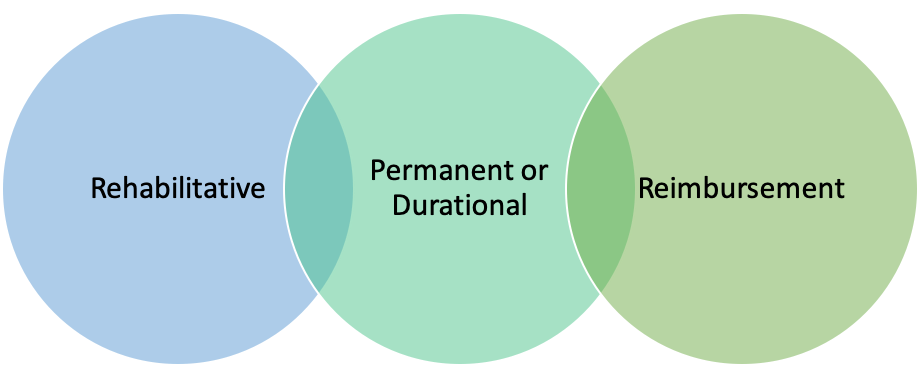
A Court may award rehabilitative alimony – alimony for a short amount of time – to empower the dependent spouse to complete any necessary training or education to assist in his/her transition back into the workforce. Permanent or durational alimony is awarded for a finite amount of time to help the dependent spouse transition into single life, while maintaining a standard of living similar to that established during the marriage. Lastly, reimbursement alimony may be awarded to a spouse who contributed to the education of the other spouse or the household while the other spouse was in school/training.
Although there are different types of support available depending on your current divorce season, the important thing to remember is that you may be entitled to or eligible for financial assistance before, during or after your divorce. Contact The Skeen Firm today at 724-550-6970 or info@theskeenfirm.com to discuss the specifics of your situation.
*Disclaimer: the advice provided is for informational purposes and is not intended as legal advice. It should not be relied on, nor construed as creating an attorney-client relationship.